Fall is coming.. what does that mean for sourdough?
Hi Sweet Early Risers,
I am really excited for the changing seasons, not that we really experience summer in San Francisco. We live close to the northern California beach which means FOG in the summer. I am really grateful to live somewhere where the heat is moderate. But, it really bums me out to not see the sun in the summer. I fear my kids won’t even really know what summer is! And while it’s still really hot most places, I wanted to give you a few reminders and tips about changing seasons and what that means for naturally fermented (sourdough) bread.
When it gets colder, everything significantly slows down. You might find yourself waiting for dough that seems to be not moving AT ALL. How can you combat the change?
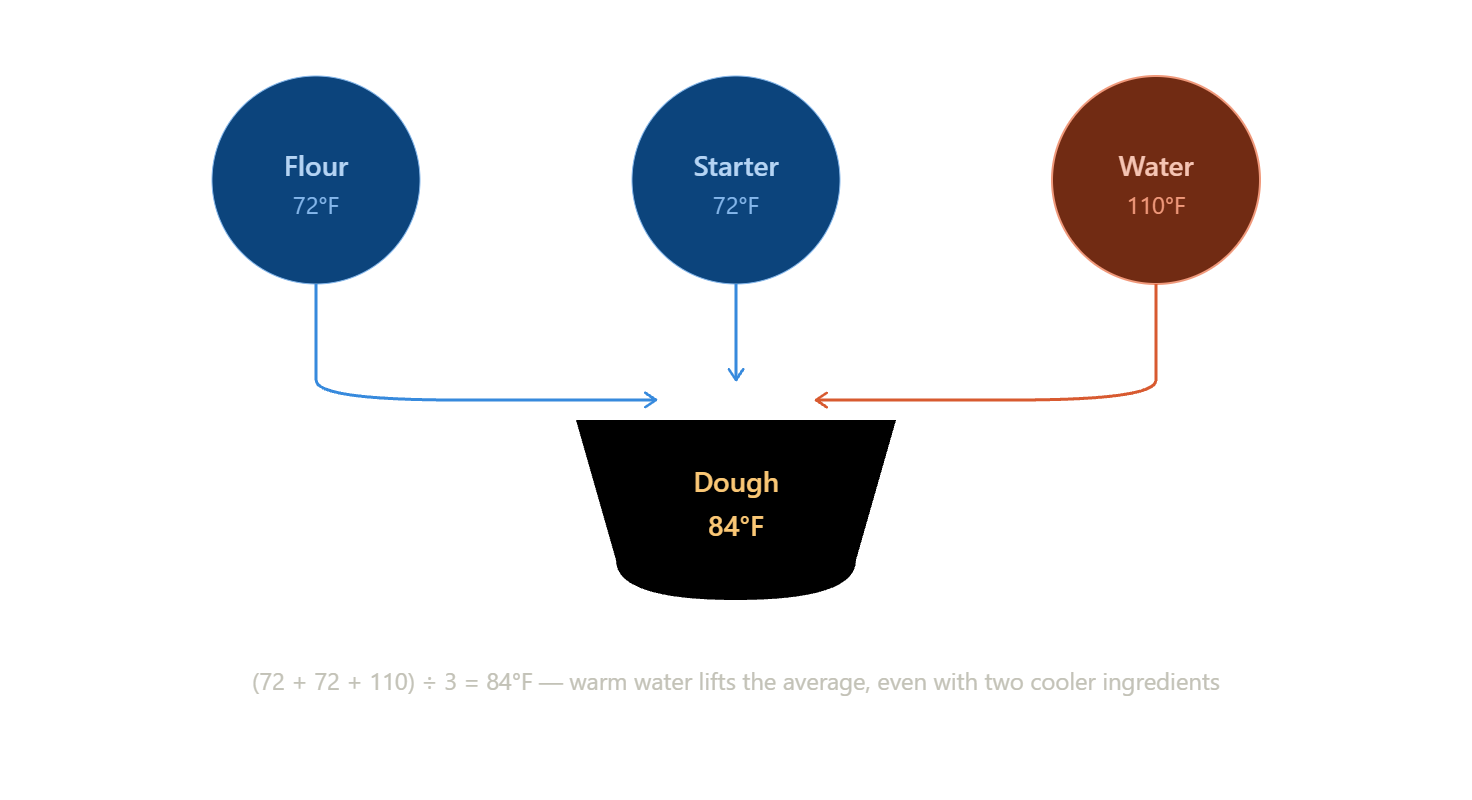
- Use really warm water when mixing. When I teach in person classes, people are typically shocked when I tell them that I use up to 110f water. “But it’ll kill the yeast!” No, it won’t. Yeast dies at between 120-130f. But you have to remember that you’re not mixing the starter with only the water. The flour + water + starter will all contribute to the final temperature. So if your water is 1 part, the starter another, and the flour the third, all three temperatures will play a role in the temperature of the dough. If your kitchen is 72°, the flour is too. If your flour is at 72°, the water at 110°, and the starter is kept on the counter, also at 72°, (72+72+110=154/3=84f.) 84f for dough is a great temperature, especially if the room is cold. The yeast will exponentially grow at that temperature and will favor mild flavor instead of sharp sourness.
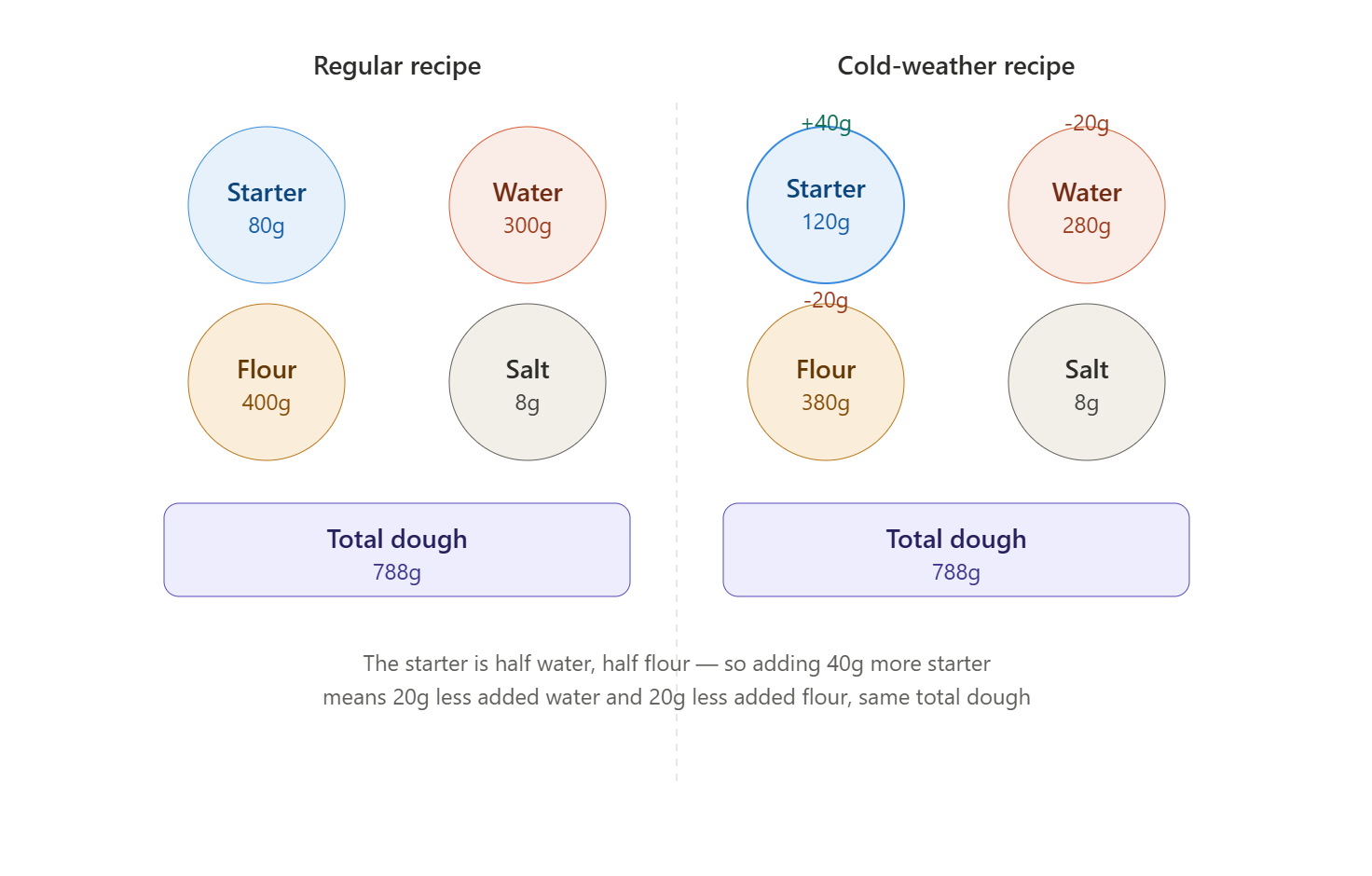
- Use more starter in your dough. While this can be a little more complicated to convert for you detailed oriented people, those of you who are more loosey-goosey with your baking can just add more starter in. What is most important to remember here is that when you add more starter there is more water in your dough (and the dough will ferment faster, lots of upfront mixing is good and so are early folds). You can simply add less water to your regular recipe and watch your dough closely. Or, if you want to actually figure out what’s going on, you can do this: Add up all the ingredients in both the starter and dough of your original recipe. So, if your recipe is 80g starter, you’d add 40g water and 40g flour to the dough totals instead of adding it as starter amounts. A basic recipe of 80g starter, 400g flour and 300g water would now look like 440g flour and 340g water. If you’d like to change it to 120g starter, you’d have to adjust the water and flour amount to reflect that. You are adding 60 of each ingredient instead of 40, so you would take 20 grams out of the water and flour totals. I hope this makes sense! So instead of adding 300g water to the recipe, you’d add 280. Same with the flour, instead of 400g flour, you’d add 380. Though, to be honest, I usually just keep some water back, feel the dough after the initial rest, and add water in if it feels too stiff. Remember not to take this too seriously, it’s just bread!
- Add more whole grains! You know that I love to use whole grains in my baking, and while whole wheat doesn’t act the same as white flour, adding some (as little as a spoonful makes an impact) into your starter will increase activity in both your starter and the dough. If you haven’t dabbled much in whole wheat, I suggest you sub 5-10% of your total flour with whole wheat and that, combined with adding a bit to your starter, will speed things up.
You can do any of all of these tips, or you can choose to stick to the same recipe you’ve always used, just make sure you account for your dough rising slower. No one wants to be up until 2 am waiting for bulk fermentation to end, and often we fall asleep and wake up to a puddle of dough, which is the worst. I hope this helps you with your changing temps and that your foray into fall baking is lovely. Anyone out there completely turn their oven off during the summer? Let me know in the comments!
Thanks, with all my love,
Laila