Do I have to use my starter at peak?
Hi friends,
I want to talk about something that comes up constantly in my DMs, in my consults, and in comments left on posts: When should you use your starter
?
You’ve probably heard to “use it at peak.” And that’s not wrong, it’s what I like to do (when I can!) But it’s also not the whole story, and I think the incomplete version of that advice is responsible for a lot of frustration, dense loaves, and bakers who feel like they’re doing everything right and still can’t figure out why their bread isn’t working. So let me explain what I’ve learned!
- * *
First, what’s even happening in your starter?
Your starter is home to two very different organisms doing two very different jobs: wild yeast and lactic acid bacteria (LAB). They coexist, they depend on each other, but they do not work on the same schedule.
Here’s the part that I really love: the yeast gets to work first. After a feeding, your yeast wakes up relatively quickly and starts producing carbon dioxide. That’s what makes your dough rise. The bacteria, on the other hand, are slower to get going. They produce the acids (lactic and acetic) that give your bread flavor. We refer to this time as “lag time”. When the yeast is already doing its thing, but the bacteria hasn’t started going yet at full steam.
- * *
Before peak: young, active, and yeasting hard
When your starter is on its way up: fed, active, rising but not yet at its highest point, the yeast is working but the acid production is still ramping up. Your starter is energetic. It’s going to give your dough a lot of lift and do it quickly. (This can be called a young levain, which was coined by Chad Robertson, the owner and ofunder of Tartine).
Baking with a young, pre-peak starter means faster fermentation, a milder flavor, and a more open crumb (if everything else goes right). This can be really useful — especially if you’re in a cold kitchen or working with a slower fermentation timeline and you need a little extra oomph. It can also be a smart move for enriched doughs (think: milk bread, buns, babka) where you want rise without a ton of tang (but don’t go too early or your dough will take FOREVER to rise, especially with a sweet stiff starter or a lower hydration one).
The trade-off is that you’re working with less acid development, which means less complexity in the flavor.
- * *
At peak: the sweet spot (most of the time)
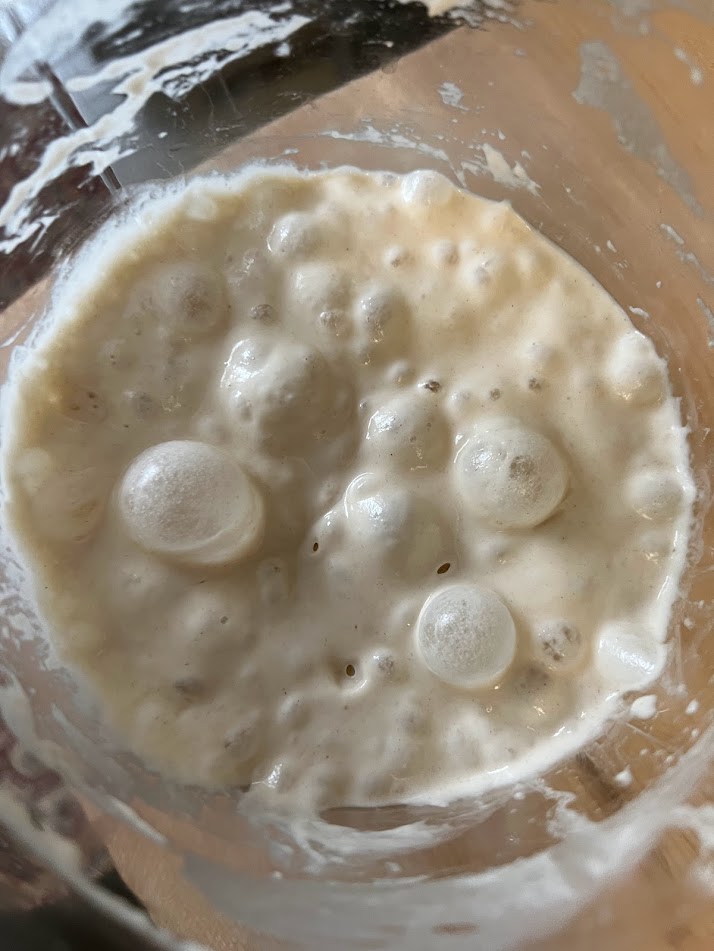
Peak is when your starter has risen to its highest point and is just starting to think about coming back down. It’s domed, it’s bubbly, it smells pleasantly sour and yeasty, and if you do the float test, it’ll probably float. (Though I’ll save my float test opinions for another post.)
At peak, you have a nice balance of yeast activity and acid development. It’s why this is the most commonly recommended window. Your starter is strong, active, and has had enough time for the bacteria to really start contributing. The flavor, the fermentation speed and the structure all tend to work together really well here.
For a classic sourdough loaf, peak is usually your best friend.
- * *
After peak: slower, more complex, and worth knowing about
Here’s where it gets interesting. Once your starter passes peak and starts to fall, it isn’t dead, it’s just shifted. The yeast activity slows down, but the bacteria keep going. The acid is still building.
A past-peak starter used carefully can actually produce some really beautiful, complex flavor. More tang, more depth, a longer fermentation window in the dough itself (because the yeast isn’t as vigorous, it all slows down). Some bakers, especially those chasing a sourer loaf, deliberately use a slightly past-peak starter.
The risk? If you wait too long, your starter is exhausted and your dough will be sluggish and under-risen. There’s a window. It’s wider than people think, but it does close.
It’s also important to not make it a habit to continuously use your starter past peak while leaving it, unfed, for hours before its replenished. If you want a sour bread, make it a habit to feed a portion of your starter before it’s super sour and use that as your continuation starter, or your mother, instead of letting ALL of it sit unfed for long periods of time.
- * *
So what does this mean for you?
It means “use it at peak” is good default advice, but you have more flexibility than you might think. It’s most important that you understand why each window behaves differently.
Young starter = faster fermentation, milder flavor. Great for enriched doughs or cold kitchens.
Peak starter = balanced lift and flavor. Your reliable go-to for most breads.
Past-peak starter = slower fermentation, more complexity. Use intentionally, not by accident. (And definitely don’t use it for enriched or very low hydration breads, they’ll take so long to rise and you’ll lose patience!)
And throughout all of it, remember the lag time. Your yeast and your bacteria are not punching the clock at the same moment. Give the process enough time for both to do their work, and your bread will tell you.
I could talk about this forever. Maybe next time I can dive into starter hydration levels or types of flour? I know using rye or whole grains in starters can be confusing. Leave your questions in the comments, because I know this one opens up a lot of follow-up curiosity.
Happy baking, Early Risers. 🍞
Laila